
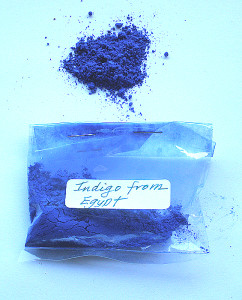
These quirky stories about pigment making from the past are completely irresistible, and Philip Ball's book, Bright Earth, is full of lively tales. The herb indigo is considered a dye rather than a pigment and is sometimes described as a lake (lac) pigment which is a commonly used word for dye. Ball quotes from a twelfth century manuscript: … [Read more...] about More Dung Stories
Pigments: Historical and Modern
There is a distinct difference between modern day pigments and the natural pigments used prior to the middle of the 1700s. In the past, artists had apprentices who ground the colors for them throughout the oil painting sessions. Because they were made by hand, the pigments retained a natural grittiness and consistency with larger particle size. Today's oil paint manufacturers make synthetic colors in huge vats where the end result is exceptional smoothness. Prior to the middle of the 1700, natural pigments came from dirt, minerals, and even plants.
Dendera, The Temple of Hathor
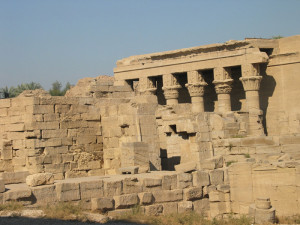
The ceiling shown in the previous entry is within this Temple of Dendera (above) which is on the west bank of the Nile in Upper Egypt. This temple has a very long history since the earliest dynasties and structures were erected throughout the various occupations. There is a birth chapel, two Roman wells, various churches, the remains of a Roman … [Read more...] about Dendera, The Temple of Hathor
Dendera Temple Ceiling Colors
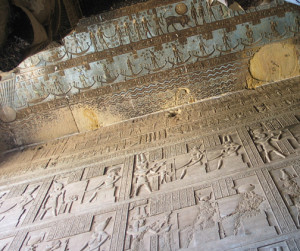
At several places within the Temple of Dendera the colors from antiquity were visible. Here you can see the remains of a bluish pigment on the ceiling. The ancient Egyptians used two blues. One is the Egyptian blue frit described in an earlier blog entry and the other azurite. It is impossible to tell which was used here without analyzing a … [Read more...] about Dendera Temple Ceiling Colors
Shores of the Nile
French Prime Time, Egyptian Style
The next phase of the project is the priming. After the canvas is totally dry sand lightly to remove the fuzzy fibers that have lifted on the surface of the fabric. Lay the canvas flat and begin the priming process on the back. Once more, remove the staples from the corners. Using a brush apply the primer to the fabric leaving the staples off … [Read more...] about French Prime Time, Egyptian Style
Priming, by Request
Rob, at French Canvas, graciously sent me one of their stretched linen canvases to use as a blog demonstration and to use for one of my Egyptian paintings. I have used their superior products in the past, and because so many people have requested more information about priming techniques, this will be a good way to show how … [Read more...] about Priming, by Request