
Born in Spain, this 17th century artist, Josefa de Obidos, was one of the most successful and revered women in the field of art during her lifetime of 1630-1684. She was proficient in many mediums but mostly famous for her still life and religious themed oil paintings. Like several of the women I have researched for this project, Obidos never married and chose to devote her life to her work. She was a savvy businesswoman who had a lucrative studio that allowed her to live independently on her own terms.
Savvy in Business Too!
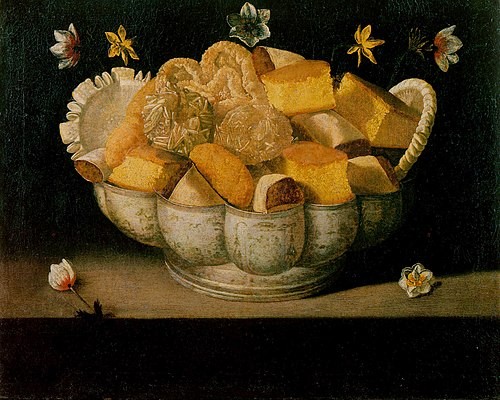
A lifelong devout Catholic, Obidos portrayed female figures as heroic in religious larger-than-life scenes. This ideation echoed her persona as she lived her daily life of virtue. In addition, her still lifes depicted commonplace household items such as flower garlands, baskets, food items, sweets, ceramics, and textiles in the Spanish Baroque design. Using the chiaroscuro technique of dramatic contrasts of light and dark, she enhanced this style with joyful color unique to Portugal.
None Other Than THE Velazquez
Josefa followed the career path of her painter father choosing the life of an artist which has always been known to be difficult for a woman. She was one of eight children born to Baltazar Figueira, and an Andalusian noblewoman, D. Catarina de Auala y Cabrera. Josefa was surrounded by painters and artists during her childhood. Her father studied with Francisco de Zurbaran and her godfather was Francisco de Herrera the Elder. In addition to this pedigree, none other than Diego Velazquez worked in Seville at that time.
Expanding Her Repertoire
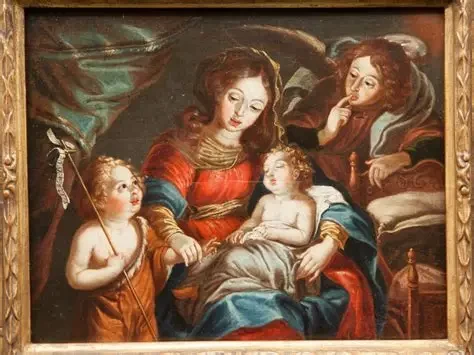
After her father was arrested for debt, the family moved to Obidos, Portugal where she spent long hours in her father’s studio continuing her growing passion for art. Here she expanded her repertoire into landscapes, still life, portraits, and religious works. For a while she received training at a convent but did not take Holy Orders.
From 1646, while just 16, Josefa began doing private commission work in engraving and painting. This continued for many years. Art historian, Souren Melikian states that “Obidos possessed a poetic feeling that redeems much of her work and a softness comes through in almost every religious subject which exudes an extraordinary sense of intimacy.”
An Astute Entrepreneur
Óbidos lead a full and fruitful artistic life producing private portrait commissions throughout the years while working on monasteries, religious buildings, and she painted portraits of the Portuguese royal family. In her later years, she became an astute entrepreneur purchasing and leasing land and also became a money lender.
In the 18th century publication, Life Stories of Woman Artists, critic Julia K. Dobbs writes, Abydos (Obidos) “is justifiably included in Froes Perym’s catalogue of illustrious women since she was, and still is, the best-known artist of seventeenth-century Portugal.”
Yet Another Forgotten Woman Artist
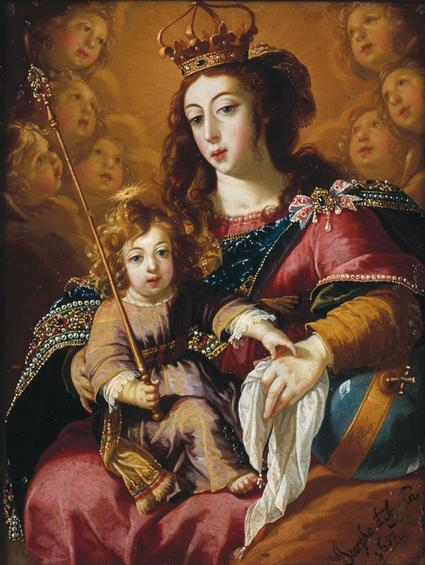
Josefa died in 1684 at the age of fifty-four. As almost every woman artist featured in this Dancing Backwards series, Josefa fell into obscurity for centuries until 1949 when Lisbon’s Museu Nacional de Arte Antiga launched a career retrospective. Even though she became the most important and prolific woman artist of the period in Portugal, she was forgotten. Over those centuries, countless male artists were featured in art literature and academia while women artists suffered willful exclusion.
Contemporary scholar, Joaquim Oliveira Caetano, says, “her painting goes far beyond being a curious case of ‘gendered art’ [and that] Josefa painted and lived her life with unusual independence, and truly created her own artistic language in Portuguese Baroque.”
Dancing Backwards in High Heels Part Two; More Lessons from Fred and Ginger. Bronze Coast Gallery, Cannon Beach, Oregon, October 11, 2025
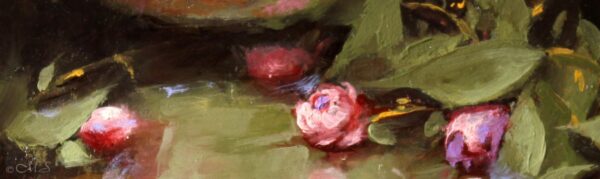
from a Josefa de Obidos select painting.
I wonder if people back then really had the larger eyes. And if they were considered more attractive or just ordinary.
Hello Joanne, What an interesting comment! I would expect that if it was just ordinary then it would not be considered an anomaly. This question has never come up before, and it might require an archeologist to answer it adequately. I looked it up, and the answer I found is that the Neanderthal did have larger eyes to accommodate for the long nights in Europe. It is speculated this could have been their demise because they had a smaller brain capacity. Homo sapiens on the other hand originated from Africa where bright sunlight prevailed. Therefore, there was no need for large eyes and eye sockets. Thusly, brain size was larger leaving room for brain/knowledge development. This is just my living room analogy. Anybody else want to jump in here?