
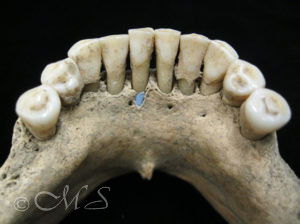
How does a 850 year old skeleton relate to Dancing Backwards? It is posited that this woman/skeleton was a scribe/artist and somehow while working on a manuscript, a small chunk of lapis lazuli pigment was accidentally embedded in the flesh of her lower jaw behind her front teeth. According to the Smithsonian Institute, scientists like to poke around in very old dental skeletal calculus to find evidence of food, bacteria, and other remains that harden over time. What they found instead of plaque and tartar was this remarkable piece of rare coveted and beautiful blue pigment.
Further study has now determined that it is plausible she was a scribe who created, painted, and copied lavishly decorated sacred illuminated manuscripts right along with the guys. According to the article, the discovery may represent the sole surviving evidence of “female scribal activity” in the area of Germany where the skeleton was found.
Dazzling Blue Beauty
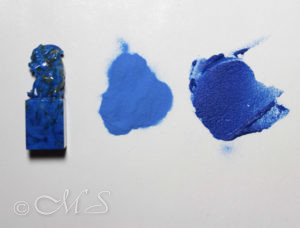
The most brilliant lapis is found in one of the most remote places in the world, Badakshan Province, Afghanistan. This presents another possible clue to the story; in Medieval times, lapis was likely imported from this remote area to many places in the world, including where this woman/skeleton lived and worked.
As Costly as Gold
The pigment was as costly as gold, and would have been used by highly skilled scribes of renown and was certainly not available to ordinary artists and scribes. Still today, it can cost hundreds of dollars per gram for a superior grade of dazzling beauty.
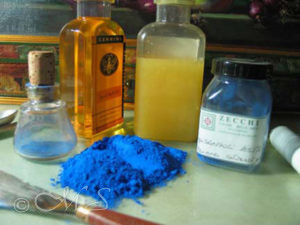
As you know, I have used lapis blue in my paintings for many years and find the history behind this pigment particularly interesting. While in Florence, Italy in 2003, I purchased several grams at Zecchi’s Belle Arte and carefully horded it for special paintings.
In 2006/07, I not only used the pigment but also hand-made the paint for my Lessons from the Low Countries project, and later for Lessons from the Pharaoh’s Tomb Part I and Lessons from the Pharaoh’s Tomb Part II.
How Did the Pigment Get There?
Over the many years of painting and teaching, I have observed the quirky habit where artists pause and will chew on the end of their paintbrush. Picture an artist in a thoughtful moment, wondering where to place the next stroke and absentmindedly inserting the tip of a paintbrush handle into their mouth. Perhaps it was by this method that a blue pigment particle was left behind, not to be discovered for 850 years!
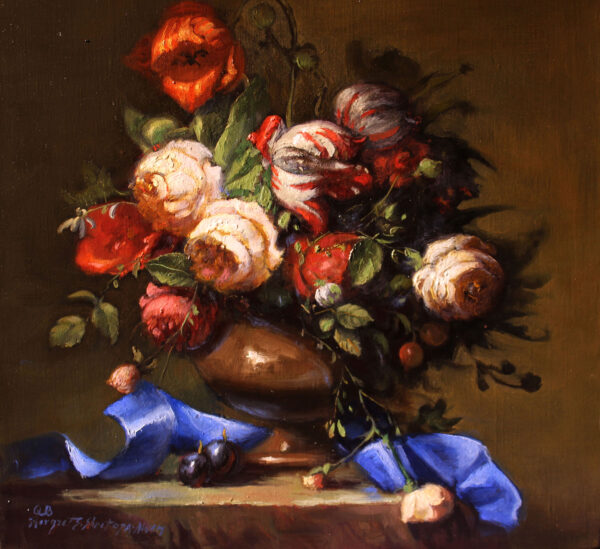
Private Collection
Dancing Backwards in High Heels Since Medieval Times
Scribes who worked during the Medieval period rarely signed their own work, so it is very difficult to determine who created the manuscript illuminations which featured this rare pigment, but there is plenty of documentation about another such scribe/author, Christine de Pisan. She was born in France in 1364 and throughout her long life she wrote novels, poetry, biography, literary, and political commentary to support her family after her husband died. In addition, she was one of the first women to write about women’s equality.

Perhaps now with this new discovery of the 850 year old skeleton, women artists’ contributions to the art world will be given a more notable and visible standing in history.
Coming in September Dancing Backwards in High Heels Part 3 to Bronze Coast Gallery: Back by Popular Demand
Christine de Pisan is one of the women artists to be featured in the coming months. The list of talented forgotten women artists is endless. In this series, many stories from very early times will highlight the lives of women who struggled but nonetheless persevered through cultural difficulties in order to follow their personal creative path.
Edited and re-posted from an earlier date.
Looking forward to Part 3! This series has been so interesting and I love learning the life stories of these artists.
Hello Holly,
Coming from an art connoisseur like you, your comment means a lot. I am so glad you enjoy the stories about forgotten women artists of the past. It is important to support and promote all of them!