
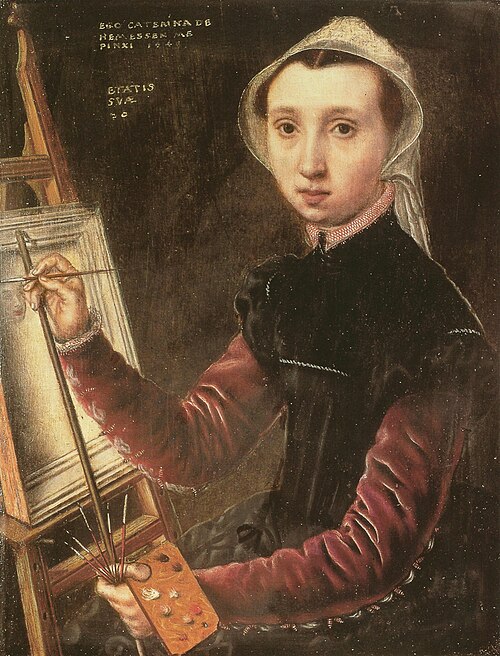
Before the Renaissance period of the 16th Century, it was rare for women artists to sign and date their work. Catharina van Hemessen, born in 1528 in Belgium, broke that spell when she did just that! She also became one of the first female artists to become known as a sought-after exceedingly skilled portrait artist featuring women subjects. Only a few of Catharina’s exquisitely executed paintings remain today but are nonetheless widely admired.
An Artistic Journey with No End
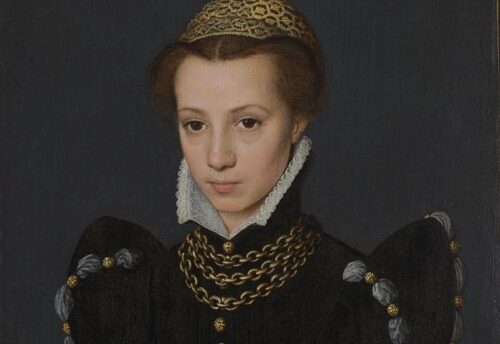
Catharina van Hemessen
The eighteenth artist in the Dancing Backwards Project was, like so many of the previous featured women, the gifted daughter of an artist, Jan van Hemessen. Early-on, her father knew she was talented. Consequently, Catharina’s training began at a very young age which helped her excel quickly on her artistic journey.
Also, like all of the other previously featured women, obstacles and barriers raised their ugly heads all along the way preventing Catharina her true recognition and access to advantages benefiting the male artists. The men on the other hand gained enormous fame and most assuredly financial gain.
Two Out of 39 are Lousy Odds
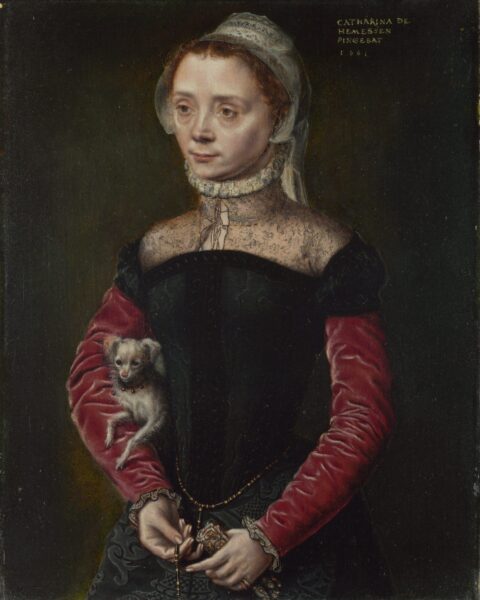
Of the list of 39 artists I found from the 16th Century Flemish period, all were men with the exception of two women. Of those two, the biographies were a scant one or two paragraphs in length showing no images whatsoever of their works. Also, like all the other featured women, even though during her lifetime Catharina built a remarkable name for herself she is rarely mentioned on any platform. Up until 2006, only six of her paintings remained known.
Fortunately, several since then have resurfaced and more attention is being paid to her legacy. Catharina’s accomplishments are many including; she was the first female Flemish artist known, thought to be the first Flemish female artist to paint a self-portrait, she was the daughter of the most important advocate for genre Flemish art, she had Royal Spanish commissions, she had a court career launched by Mary of Hungary, and was a member of the Guild of St. Luke at a time when women struggled to have access to artistic training of any kind. Of immense importance is that Mary of Hungary gave Catharina a generous pension to live on which enabled her to continue pursuing her painting career.
Money Talks
Two critical factors have continually surfaced throughout my project research that shows a clear advantage to these women. They are as follows; the important benefit of being the offspring of an artist who generously passes on their knowledge, and the importance of having independent means. Both certainly played a critical role in the life and career of Catharina van Hemessen.
The saga continues. More stories of forgotten women artists coming. As before, I will be researching the color palettes of women artists and replicating those colors in new paintings throughout the summer. The list is endless and some are as far back as the 5th Century BCE in Greece.
Dancing Backwards 3 Coming in September 2026 at Bronze Coast Gallery, in Beautiful Cannon Beach, Oregon. The legend of ” Ginger Rogers did everything Fred Astaire did only backwards and in high heels.” Ann Richards.
Hi Margret,
Thank you for your emails. Just to update you, my pet portraits and waterscapes have been keeping me very busy! And for that I am grateful. Going to try doing more florals and people portraits between the commissions; seems to break up the tedious details and many brush strokes on animals at times. It helps to relax and let loose right?!!! I am always for ever so grateful for your critiques, wisdom and encouragement. I still have my notes from when we talked back in 2012???!
Sincerely,
Kathryn Rahill. (friend of Joanne Yost)
Hello Kathryn,
I am so happy to know you are enjoying the Dancing Backwards stories of forgotten women artists. And, I am so glad you are thriving and continuing with your artwork especially your commissions. It is so therapeutic to pursue our passion for art! Stay in touch, Margret