
One innovative way to meet your future spouse – create illustrations of fossil fish for the guardian of the Museum of Royal Dublin who just happens to be a young paleontologist himself. Phoebe Anna Moss did just that and ultimately married the young keeper. Phoebe was an endlessly gifted participant in the Arts and Crafts movement of the late 1800s who was skilled in multitudes of genres. Her talents were breathtaking in scope ranging from manuscript illumination, bookbinding, enamelwork, furniture ornamentation, painting both easel and mural, and not forgetting detailed fossil renderings.
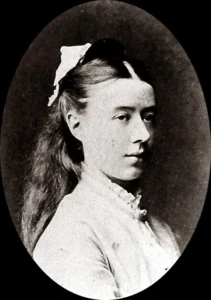
Phoebe Anna Moss, born in Dublin in 1852, is another perfect example of the importance of having strong family ties. Her physician father, Dr. William Moss, and her mother, Teresa, were instrumental in encouraging their daughter to pursue her passion and talent within the art world. As usual, this was a risky field to embark on for all the obvious reasons such as societal mores along with many of the same restrictions and barriers confronted by other women featured in this series.
An Auspicious Union
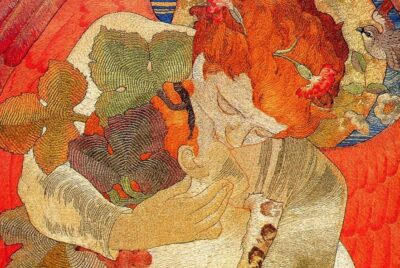
Phoebe’s marriage to Ramsay Traquair was an auspicious union. After he was chosen Keeper of the Natural History at the Museum of Science and Art in Edinburgh, Phoebe worked tirelessly creating meticulous drawings for Ramsay’s research until he retired in 1906. Ramsay Traquair, throughout his life, formed relationships with important notables who helped further Phoebe’s career and involvement in the Arts and Crafts and the Pre-Raphaelites. Through these connections, Phoebe garnered many commissions to paint murals in both public and private institutions.
Masterful Harmonious Palette
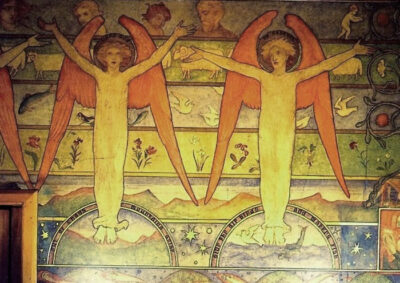
In her staggeringly prolific following years, Phoebe created a delicate four-paneled embroidered piece and a drapery series titled, The Progress of a Soul. In addition, Sonnets from the Portuguese by Elizabeth Barrett Browning came to life through texts illuminated by Phoebe. From my research, Traquair never stopped creating, illustrating books, and designed enamel-work and jewelry.
An Honorary Membership, Finally
After her husband’s death, Phoebe traveled extensively to many exotic places including Egypt, North Africa and France all the while creating sketches and embroideries until her eyesight began to fail. The Royal Scottish Academy finally awarded her an honorary membership in 1920 after earlier being declined admission. Ever an artist until the very end, her own gravestone, carved by the British sculptor Pilkington Jackson, was designed by Phoebe herself. She was buried next to Ramsay upon her death at age 84.
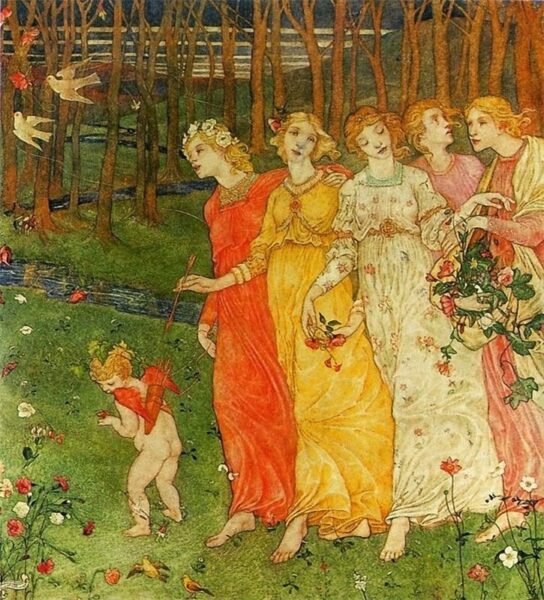
In her obituary in The Times, Sir James Caw, National Galleries of Scotland retired director, described Phoebe as, ‘a little woman and sparely built but overflowing with nervous energy (whose) … artistic activities were remarkable both in extent and quality.’ A fate befallen by every other women artist featured in this series, Phoebe Traquair disappeared from the public eye for many decades until the end of the 20th century. Finally, the scope of her astonishing creativity was rediscovered, and galleries and museums began at long last to reconsider her monumental contribution to Scotland’s art community.
Dancing Backwards Part 3: Reception, Saturday, September 12, 3 to 5 o’clock
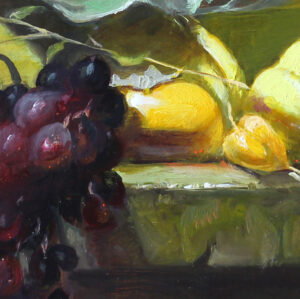
Nine new paintings to be revealed, each inspired by the palette of the women artists featured in Dancing Backwards in High Heels Part 3.
Art and lives of forgotten women artists discussed in this project called Dancing Backwards in High Heels Coming in September 2026 at Bronze Coast Gallery, in Beautiful Cannon Beach, Oregon. The legend of ” Ginger Rogers did everything Fred Astaire did only backwards and in high heels.” Ann Richards.The lives of each artist can be found here on this blog beginning in early 2025.
Images: Public Domain
Leave a Reply