
During my research for this project, I have yet to delve so far back in history and this artist may be the most complex I have featured so far. The dilemma is having to coalesce religion, artistic skills of an Alsatian Nun, and feminism into one story about nuns, priests, and a convent during Medieval times.
The Hortus Deliciarum
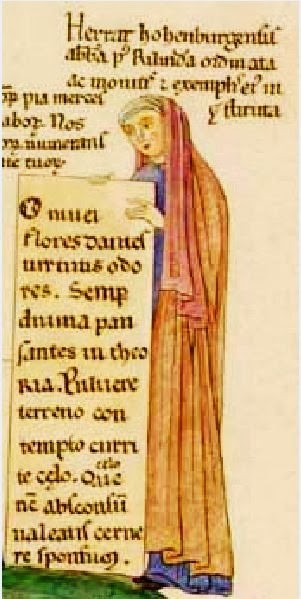
Born circa 1130 into a noble Alsatian family, Herrad von Landsberg joined the Hohenburg Abbey located near Strasbourg in the mountains of Vosges. The thriving abbey was under the leadership of Abbess Relinda who was from a Bergen Benedictine monastery supported by the Holy Roman Emperor Frederick Barbarossa. The young Herrad was blessed to enjoy the most wide-ranging education offered to women during this time in a monastery. Because of her skills and high standard of schooling, she advanced quickly as a teacher to her fellow nuns. Later in 1167 when Relinda died, she became abbess.
Garden of Delights
During her 28-year reign as an accomplished and gifted leader of the abbey, Herrad restored the building itself, and secured ownership of the land around the monastery. It was also during this time that she began to develop her most well-known work, The Hortus Deliciarum, Garden of Delights. This 648-page comprehensive work was a compilation of all the sciences taught during those years to women in the convent.
Twenty-six Years, Six-hundred and forty-eight Pages, Three-hundred thirty-three Images
Focusing on conflicts between Virtue and Vice covering biblical, moral, and theological studies, the project spanned a period of 26 years, from 1159 to 1185. Copious dramatic illustrations, 336 in all, were mostly created by Herrad and written in Medieval Latin, and Old High and Middle High German with over 1250 annotations. Most images are observations and interpretations of literary, metaphysical, and mystical themes. Some are depictions of history, encounters experienced by the artist herself, or portraits of religious colleagues within the monastery. This monumental gem was a communal effort but was for the most part edited, written, and created by Herrad including the poems and hymns.
Much of the manuscript itself took many twists and turns throughout the centuries changing hands or damaged in flames of war and uprisings. But the parts that were salvaged are revered and admired by historians today. It is difficult to imagine that this Alsatian Nun could have such a powerful impact and insight into the lives of women in general and feminism specifically in the 12th century. With her tenacity and position shown through her Hortus Deliciarum, she boldly illustrated how a woman could speak her mind and create a personal legacy. This was during a period when women were strictly tied to taking life’s instructions from local priests or communal chaplains only. Herrad proved women could and should be educated fairly and equally just as men.
Seven Liberal Arts by Herrad von Landsberg
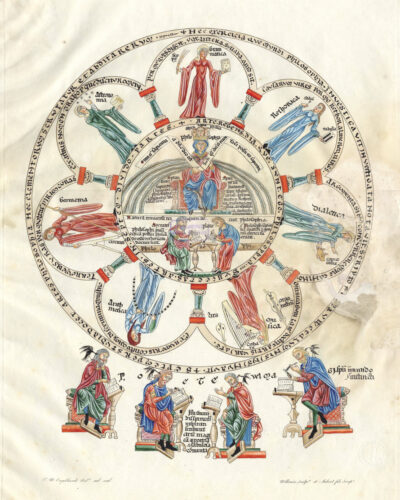
Arrayed around the circle are the liberal arts. Three correspond to the rivers which emerge from Philosophy’s left and are concerned with language and letters: grammar, rhetoric, and dialectic. Source
Dancing Backwards Part 3: Reception, Saturday, September 12, 3 to 5 o’clock
Eight new paintings to be revealed, each inspired by the palette of the women artists featured in Dancing Backwards in High Heels Part 3.
Art and lives of forgotten women artists discussed in this project titled Dancing Backwards in High Heels Coming this weekend September 12, 2026 at Bronze Coast Gallery, in Beautiful Cannon Beach, Oregon. The legend of ” Ginger Rogers did everything Fred Astaire did only backwards and in high heels.” Ann Richards.The lives of each artist can be found here on this blog beginning in early 2025.
Leave a Reply